Emerging Trends in Robotics - Why India Must Build a Future-Ready Community Now
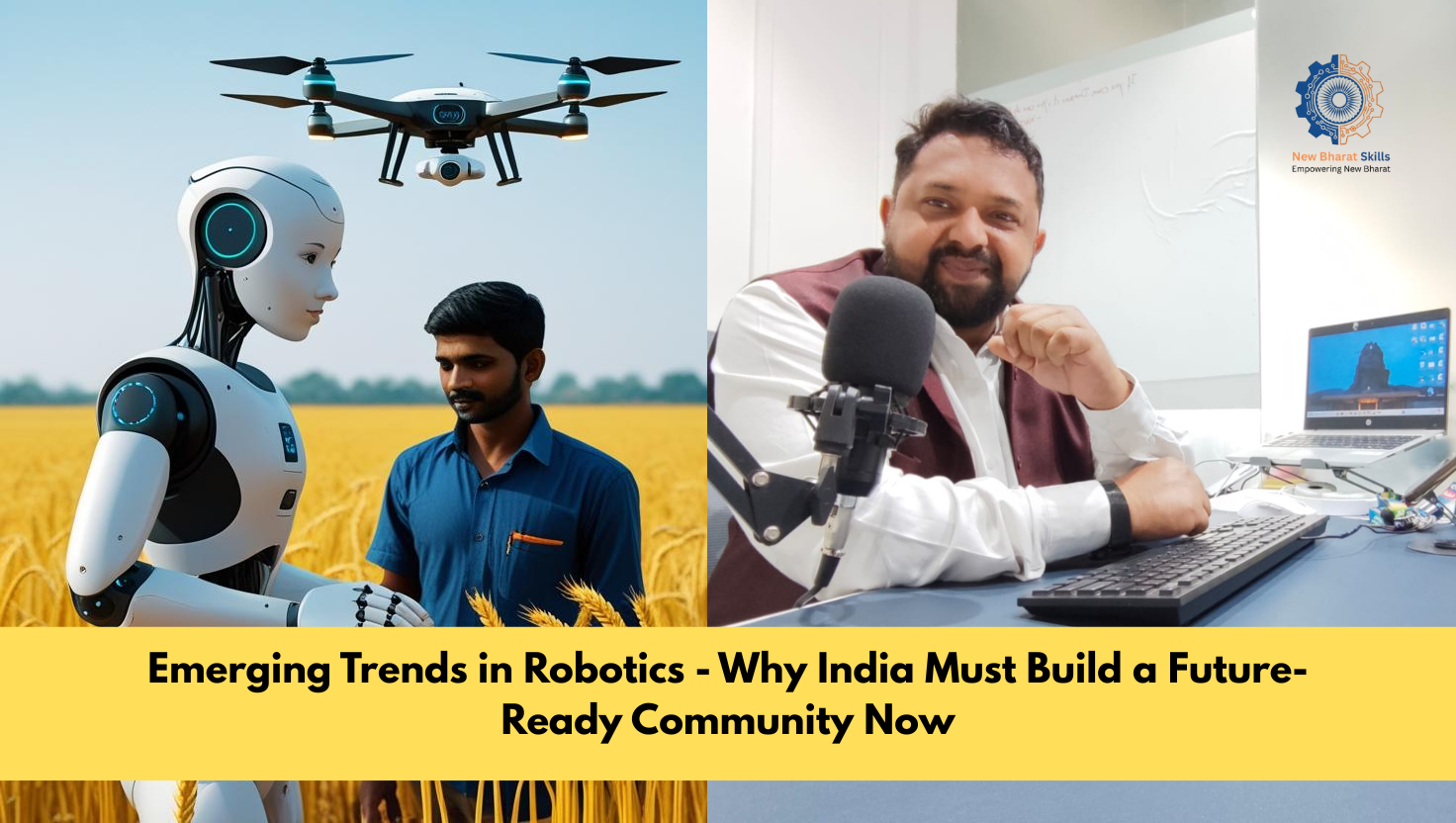
The field of robotics engineering is rapidly evolving and shaping the future of industries, services, and even personal life. Globally, investments in robotics are growing exponentially — and India is no exception. However, to truly harness the power of robotics, India must not only adopt new technologies but also build a strong community of thinkers, creators, and problem-solvers. In this blog, we explore five of the most impactful trends in robotics and why it is crucial for India to embrace them — not just as a consumer, but as an innovator.
1. 🤖 Humanoid and Social Robots: A New Face of Interaction
From Japan’s elderly-care robots to Tesla's Optimus prototype, humanoid robots are becoming a bridge between humans and machines. These robots can:
Recognize human emotions
Respond to verbal commands
Perform human-like gestures
India’s aging population and growing demand for healthcare workers make humanoid and assistive robots a vital need. Imagine a Marathi-speaking caregiving robot assisting senior citizens in Pune — this is not science fiction anymore.
Reference:
Tesla AI Day 2022 - Tesla Optimus Humanoid Robot
Hanson Robotics – Sophia Robot (https://www.hansonrobotics.com/sophia/)
2. 🚚 Autonomous Mobile Robots (AMRs) and Drones: Reimagining Mobility
Warehouses, last-mile delivery, disaster relief — AMRs and drones are redefining logistics and automation. These robots are equipped with AI, SLAM (Simultaneous Localization and Mapping), and IoT for seamless navigation.
In India, companies like Zypp Electric, Garuda Aerospace, and DRDO are already innovating in drone tech for both civilian and defense use.
We need low-cost, India-specific navigation solutions for our crowded streets, rural terrains, and monsoon-affected areas.
Reference:
Garuda Aerospace (https://www.garudaaerospace.com/)
DRDO Autonomous Surveillance Systems (https://drdo.gov.in)
3. 👁️🗨️ AI-Powered Vision and Perception in Robots
Computer vision combined with AI enables robots to:
Identify defects in manufacturing
Navigate autonomously
Interact with physical environments
In Indian factories, AI-powered visual inspection can drastically improve product quality, reduce errors, and boost productivity — essential for Make in India 2.0.
For robotics startups, tools like OpenCV, YOLO, TensorFlow, and ROS 2 are becoming essentials.
Reference:
OpenCV AI Kit (https://opencv.org)
NVIDIA Isaac for Robotics AI (https://developer.nvidia.com/isaac-sdk)
4. 🏥 Healthcare and Assistive Robotics: From Surgery to Rural India
India faces a dual healthcare challenge:
Urban overload in hospitals
Limited access in rural areas
Robots are stepping in with:
Surgical precision (e.g., Da Vinci Surgical Systems)
Telepresence and diagnostics
Wearable exoskeletons for rehabilitation
The integration of robotics in Ayushman Bharat and PM Gati Shakti initiatives can transform healthcare delivery across India’s vast geography.
Reference:
Intuitive Surgical’s da Vinci system (https://www.intuitive.com/en-us/products-and-services/da-vinci)
Wipro’s Assistive Robot Projects
5. 🐜 Swarm Robotics and Multi-Agent Systems: Inspired by Nature, Built for Scale
Think ants, bees, or birds. Swarm robots use simple rules but collectively achieve complex tasks. In India, this has potential in:
Agricultural automation
Search and rescue in natural disasters
Defense and surveillance in border regions
Startups like TartanSense are already using small robot swarms to manage farm operations. This is an opportunity to lead the world in low-cost, high-volume swarm robotics.
Reference:
TartanSense: Building agricultural robots for small Indian farms
Swarm robotics paper by IISc Bangalore, 2023
🇮🇳 Why India Must Build a Robotics-Ready Community Now
India is at a critical juncture:
We have the largest youth population in the world.
NEP 2020 is opening doors for skill-based learning.
Global supply chains are looking at India as a design and innovation hub.
But challenges remain:
Access to robotics education is limited to metro cities.
Awareness in Tier 2/3 towns is still low.
There’s a huge skill gap between academic learning and real-world robotics.
🌱 What We Need to Do — Together
Promote robotics clubs and labs in schools and colleges (especially government and rural institutions).
Create community learning spaces — hackathons, tinker labs, demo days.
Encourage Indian-language content and kits tailored to our education system.
Link students with startups and real projects, not just theory.
🔭 Being Future Ready: Not a Choice, But a Necessity
Robotics is not just a fancy topic — it’s at the heart of industry 4.0, digital India, smart cities, and clean-tech missions. If we wait, we will be left behind as mere users of imported technology. If we act now, we can lead the way in "Make in India" for the world.
🔗 Conclusion
These 5 trends are not just futuristic buzzwords. They are the building blocks of India’s future economy and social structure. The time to build awareness, skill, and community is now. Through platforms like New Bharat Skills, local makerspaces, and forward-thinking educators, India can rise — not just as a technology adopter, but as a global robotics leader.
💬 "Let’s not wait to be taught. Let’s start building together — in our labs, classrooms, villages, and cities. Because robotics is not just the future — it’s our future."
Posted on: 2025-06-30 06:07:10
Leave a Comment
Comments
No comments yet.